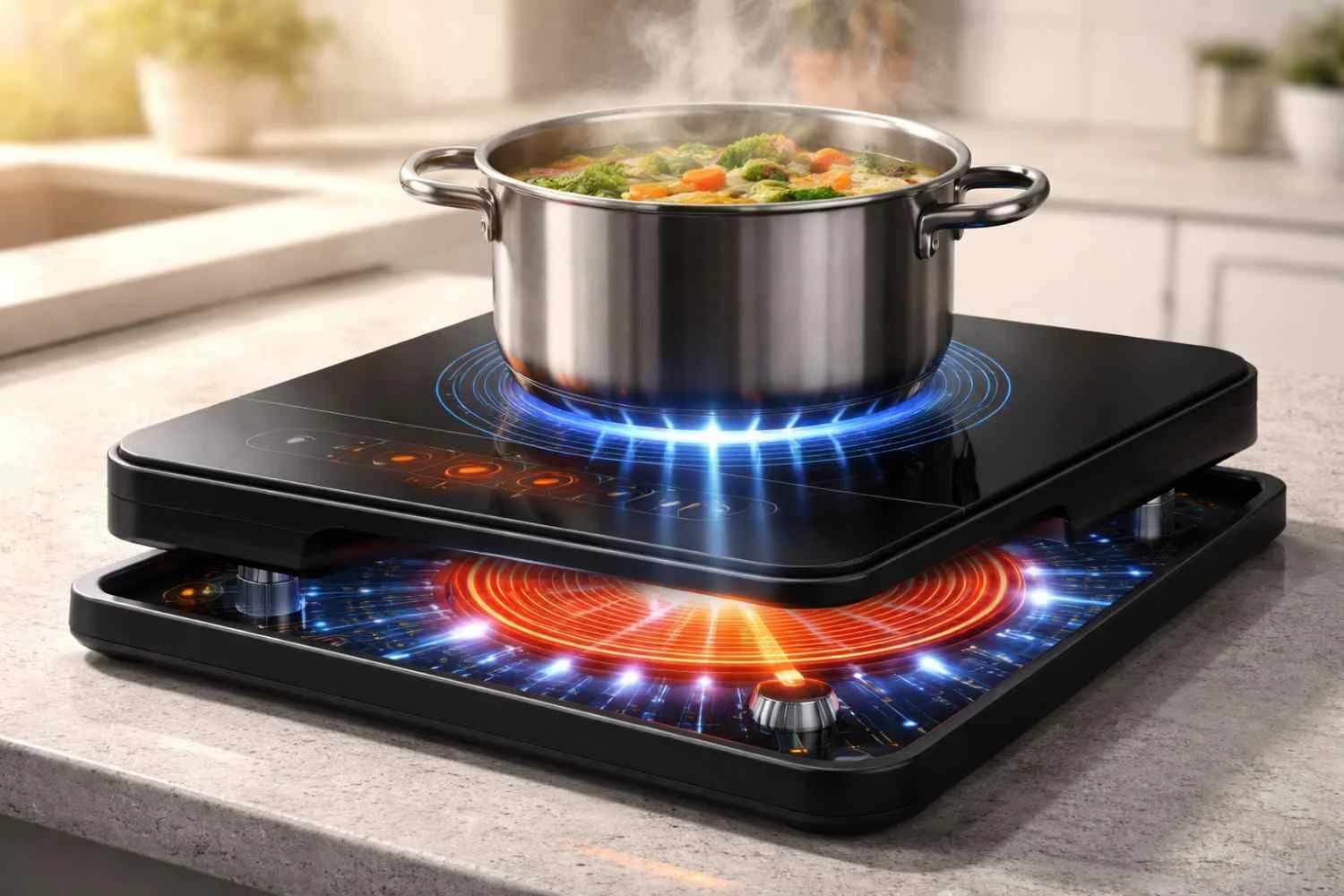
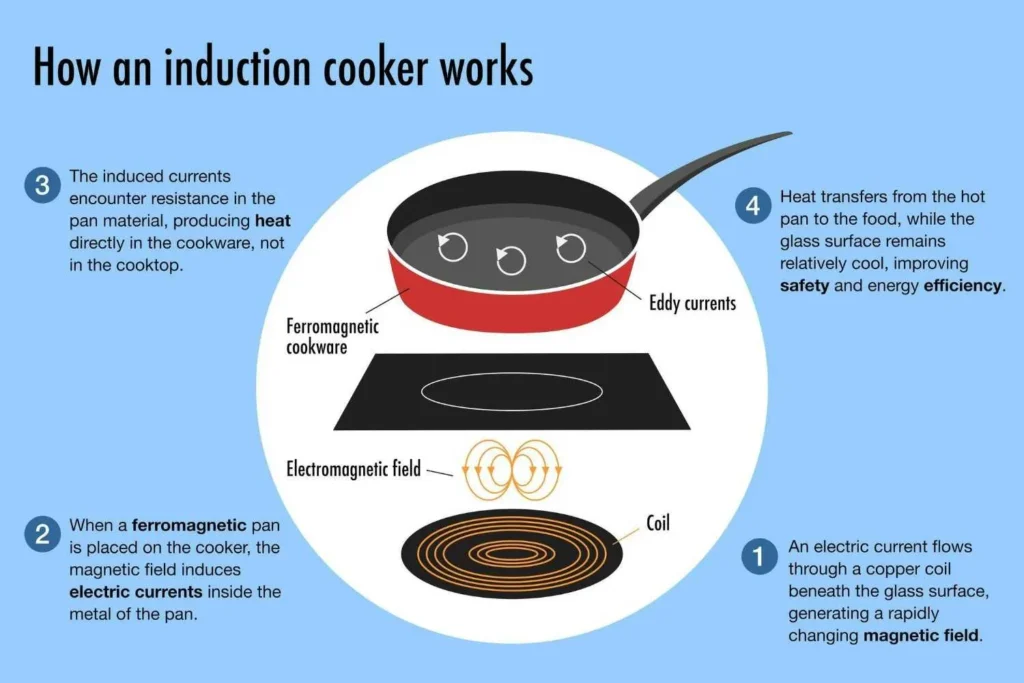
How an induction cooktop works is simple to understand. It uses electromagnetic energy to directly heat the cookware instead of the surface. When you place a compatible pan, an electric current creates a magnetic field, which generates heat inside the pan itself, cooking food faster and more efficiently.
What Is Induction Cooking
Induction cooking is a modern method that uses electricity and magnetism to generate heat directly inside the cookware. Unlike gas or traditional electric stoves, the cooktop itself stays relatively cool.
If you’re exploring options, refer to this collection of induction cooktop models designed for efficient cooking.
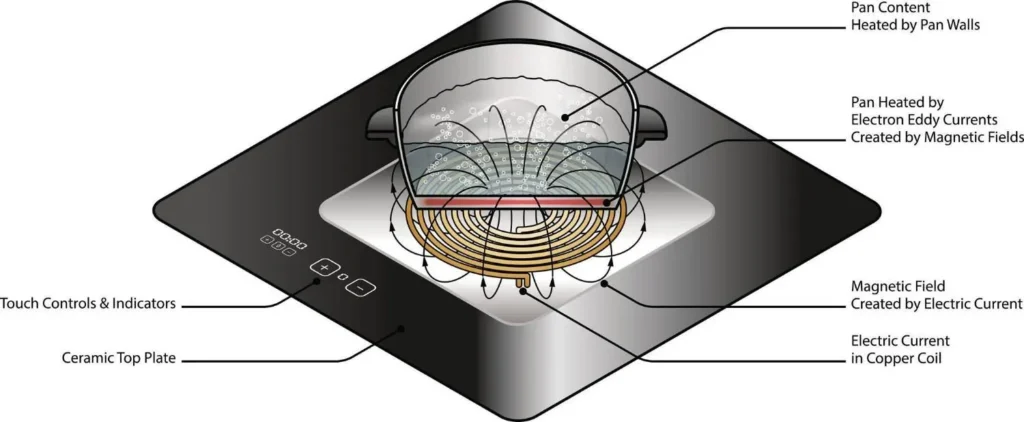
Induction Cooktop Working Diagram
Components of an Induction Cooktop
Every induction cooktop may look simple on the outside. Inside, it’s a smart system working together:
● Copper coil – Generates the magnetic field
● Glass surface – Heat-resistant and smooth
● Control panel – lets you adjust temperature and power
● Power supply – Converts electricity into usable energy
How Does an Induction Cooktop Work? (Step-by-Step Process)
Step 1: Electricity Flows Through Coil
When you turn on the cooktop, electricity flows through the copper coil placed under the surface. Summary: Power activates the system.
Step 2: Magnetic Field Is Generated
The flowing current creates a high-frequency magnetic field above the cooktop surface. Summary: Magnetic energy is created.
Step 3: Heat is produced inside the pan.
If the pan is magnetic, the field induces currents inside it, generating heat. Summary: Heat forms inside the cookware.
Step 4: Food Gets Cooked
The heated pan transfers heat to the food, cooking it evenly and quickly. Summary: Cooking happens efficiently.
The Science Behind Induction Cooking
Let’s keep this simple.
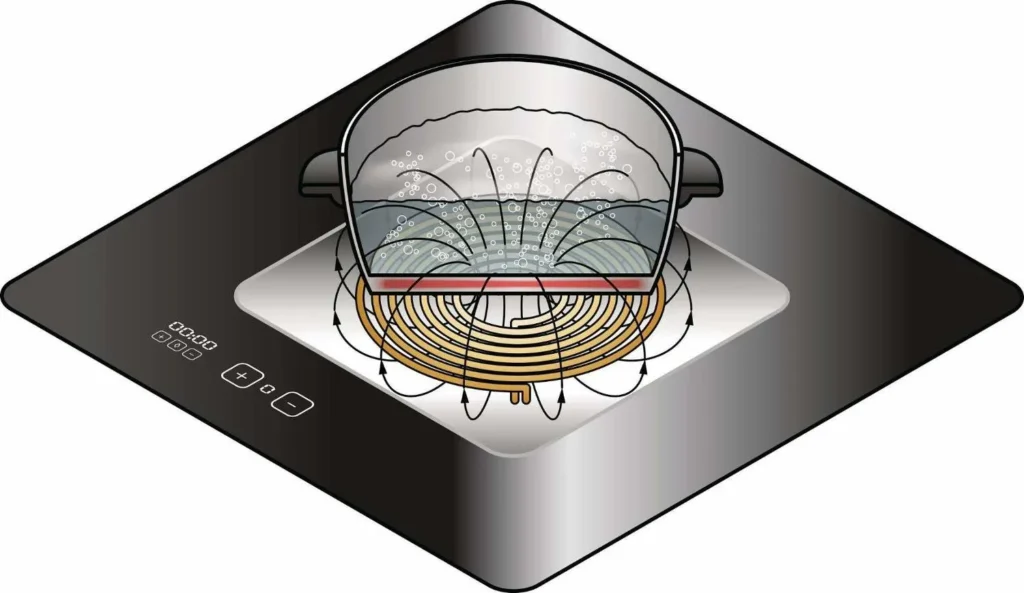
Induction cooking works on a principle called electromagnetic induction. When electricity flows through a coil, it creates a magnetic field.
Now here’s the intriguing part. When you place a magnetic pan on top, tiny electric loops called eddy currents form inside the pan. These currents generate heat instantly.
Think of it like this. Instead of heating the stove and then the pan, induction skips the middle step. It heats the pan directly.
Why Induction Cooktops Heat Faster Than Gas
Gas stoves heat the air around the pan. Some heat escapes.
Induction cooktops send energy straight into the pan. No wastage.
That’s why water boils faster and cooking feels quicker.

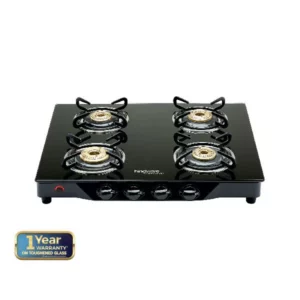 Armo GL 4B AI BLK Glass Cooktop
3 × ₹11,390.00
Armo GL 4B AI BLK Glass Cooktop
3 × ₹11,390.00 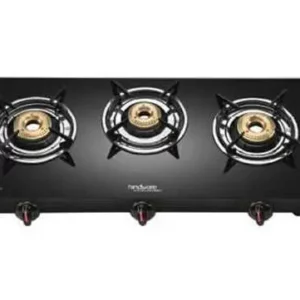 Skip to the end of the images gallery SAVE50% Skip to the beginning of the images gallery Hindware Benecio 69 cm 3 Brass Burner Auto Ignition Cooktop - Black
1 × ₹7,990.00
Skip to the end of the images gallery SAVE50% Skip to the beginning of the images gallery Hindware Benecio 69 cm 3 Brass Burner Auto Ignition Cooktop - Black
1 × ₹7,990.00 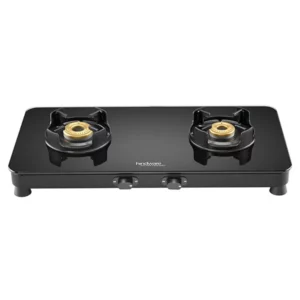 KA Cooktop Alverio 2B AI
1 × ₹9,690.00
KA Cooktop Alverio 2B AI
1 × ₹9,690.00 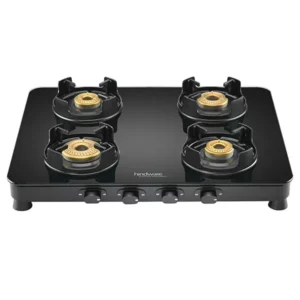 KA Cooktop Alverio 4B AI
1 × ₹13,490.00
KA Cooktop Alverio 4B AI
1 × ₹13,490.00 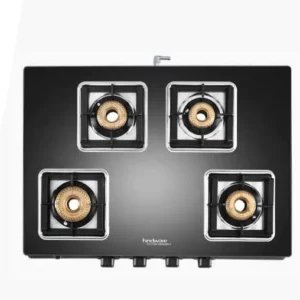 Hindware Arsenio Plus 4b Cooktop
1 × ₹14,990.00
Hindware Arsenio Plus 4b Cooktop
1 × ₹14,990.00