
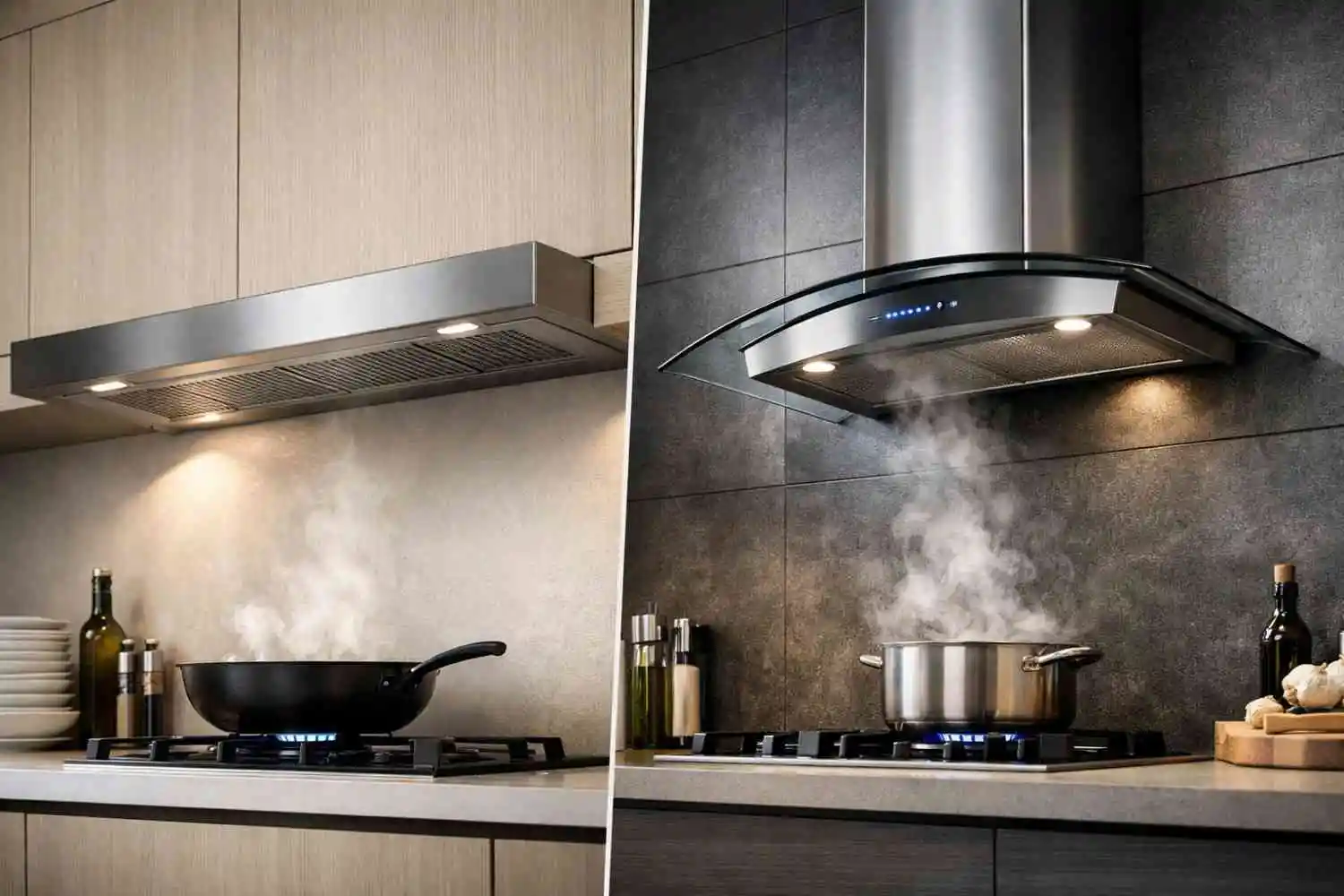
Straight Line Chimney vs Curved Chimney – Which Is Better
When you start planning a modern kitchen, the chimney quickly becomes one of the most important appliances to get right. It affects how your kitchen looks, how it smells, and how easy it is to keep clean. That’s exactly why many homeowners end up debating straight-line chimney vs curved chimney when finalizing their design.
Both types do the same basic job – they suck out smoke, oil, and cooking fumes. However, the way they fit in your kitchen and the experience they offer can be quite different. In this detailed chimney comparison, you’ll see how they differ in design, performance, space usage, price, and maintenance so you can confidently pick the best chimney design for your home.
Straight Line vs Curved Chimney Comparison Table
| Feature | Straight Line Chimney | Curved Chimney |
| Design | Flat, modern | Curved glass design |
| Space Usage | Space-efficient | Requires more depth |
| Suction Coverage | Better for heavy cooking | Moderate |
| Maintenance | Easier to clean | Glass needs frequent cleaning |
| Best For | Modular kitchens | Design-focused kitchens |
| Price Range | Practical pricing | Often slightly higher |
In simple terms, a straight-line model is more about function and efficient coverage, while a curved chimney leans more toward style and visual impact
Understanding the Two Designs
Before diving into which one is “better,” it helps to understand what each design actually offers and how that affects daily use.
1. What is a Straight-Line Chimney?
A straight-line chimney is usually compact, flat, and designed to sit flush against the wall or under a cabinet. It doesn’t jut out as much and often blends seamlessly with overhead storage. In many modular kitchens, it almost looks like an extended part of the cabinet line rather than a separate appliance.
Key characteristics:
● Flat, boxy, or slim design
● Works well in small and mid-size kitchens
● Usually placed directly over the hob, aligned with cabinets
● Focused on maximum suction coverage within a compact space
This makes it a very practical pick in a straight line vs curved chimney comparison if you cook regularly and don’t want your chimney to dominate the look of the kitchen.
2. What is a Curved Chimney?
A curved chimney features a glass canopy that arcs outward. This canopy is often transparent or tinted glass, paired with a sleek metal body. It’s designed to stand out and become a focal point above your stove or hob.
Common traits:
● Curved glass hood with a stylish profile
● Slightly deeper projection into the kitchen space
● Often used in open kitchens or where aesthetics are a priority
● Gives a “premium” look to the cooking area
While it can still perform well, many people select it as the best chimney design purely from a style point of view rather than for compactness or easy cleaning.
Design and Aesthetics: Style vs Subtlety
When you compare a straight-line chimney vs a curved chimney, design is usually the first visible difference.
1. Straight-Line Chimney: Minimal and Integrated
If you like clean lines and a clutter-free look, a straight-line chimney fits right in. It:
● Aligns with overhead cabinets for a seamless look
● Feels more “built-in” than “decorative.”
● Suits minimalist, contemporary, or compact kitchens
Because it doesn’t project too far into the kitchen, it also makes the space look more open and less bulky, especially in smaller homes.
2. Curved Chimney: Statement and Showpiece
A curved chimney is for those who want their kitchen to make a statement. Its glass arc is:
● Eye-catching and stylish
● Ideal for show kitchens or open-plan living areas
● Great when you want the chimney to act like a design highlight
However, that same glass that provides the premium look also demands more care, which becomes a factor when you consider long-term maintenance in this chimney comparison.
Space Usage: How Much Room Do You Really Have?
Space is one of the biggest deciding factors between a straight line and vs curved chimney.
1. Straight-Line Chimney: Space-Efficient Workhorse
Straight-line chimneys typically:
● Take less depth from the wall
● Allow overhead cabinets on both sides and sometimes above
● Work nicely even in narrow galley kitchens
If your kitchen is compact or you already feel tight on space, the space efficiency of a straight-line chimney is a huge plus.
2. Curved Chimney: Needs Extra Breathing Space
Curved chimneys usually:
● Extend more into the kitchen because of the protruding glass hood
● Look better when there’s some open wall space around them
● May limit upper cabinet space directly around the unit
They don’t necessarily make your kitchen cramped, but they do demand more planning so they don’t clash with cabinets or make the cooking area feel crowded.
Performance and Suction Coverage
At the end of the day, the main job of any chimney is to keep your kitchen free from smoke and sticky fumes. This is where straight-line models often pull ahead, especially for Indian cooking.
1. Straight-Line Chimney: Better Coverage for Heavy Cooking
Many straight-line models are designed with:
● Strong suction focused directly over the hob
● Wide coverage, ideal for 2–4 burner stoves
● Good performance even when you cook oily or spicy dishes regularly
Because of their flat underside and placement, they tend to trap and channel rising fumes more efficiently in smaller and mid-sized kitchens. This makes them a solid choice if you cook multiple meals daily and use deep frying or tadka often.
2. Curved Chimney: Good, But Often More About Looks
Curved chimneys do offer effective suction, especially modern models with higher airflow ratings. However:
● The curved design sometimes prioritizes aesthetics over raw coverage
● Suction may feel slightly less focused in compact spaces
● Performance is still decent for moderate cooking, but might not feel as efficient in very heavy, frequent frying
This doesn’t mean a curved chimney is weak. It simply means that if you’re choosing purely on heavy-duty performance, the straight-line side of the straight-line chimney vs curved chimney debate usually has the edge.
Noise, Controls, and User Experience
Every day experience isn’t just about suction. It’s also about noise, controls, and how easy the unit is to live with.
1. Noise Levels
Noise depends more on the motor and build quality than on whether the chimney is straight-line or curved. However:
● Straight-line chimneys sometimes feel quieter simply because they sit tucked away and closer to cabinets.
● Curved chimneys, with their exposed design, may make noise a bit more noticeable in open layouts.
When comparing models, it’s smart to check the noise rating (in dB) along with the design.
2. Controls and Features
Both designs usually offer:
● Push-button, touch, or motion sensor controls
● Multiple speed levels
● LED lights
● Baffle or filterless technologies, depending on the brand
The design doesn’t restrict features too much; you can find advanced features in both straight-line and curved types. So, when choosing the best chimney design, consider the controls and technology along with the design.
Maintenance and Cleaning
Maintenance is often where the decision becomes very clear for busy households.
1. Straight-Line Chimney: Easier to Clean
Straight-line chimneys generally:
● Have flat, metal surfaces that are easier to wipe
● Don’t show stains as quickly as glass
● Offer easy access to filters or filterless parts
For Indian-style cooking with oil splashes, a flat metal body is much easier to manage. You can quickly wipe it after cooking and do a deeper clean weekly or monthly, depending on usage.
2. Curved Chimney: Glass Needs Extra Care
Curved chimneys look stunning, but:
● Glass readily shows fingerprints, oil splashes, and dust
● Needs frequent cleaning to stay clear and shiny
● Hard water stains or dried oil marks can be stubborn if ignored
In other words, you pay a “maintenance cost” for the stylish curved look. If you don’t enjoy frequent cleaning, this might become annoying over time.
Which Chimney Is Better for Modular Kitchens?
For modular kitchens, a straight-line design usually fits more naturally into the layout, both visually and practically. It can align with wall cabinets and still offer strong coverage, especially when you choose a modern straight-line chimney that’s designed for today’s compact yet high-function kitchens.
Here’s why straight-line chimneys often win in modular setups:
● Layout compatibility: Modular kitchens rely on symmetry and intelligent storage. Straight-line chimneys integrate well with standard cabinet widths and heights, so they don’t disturb the overall design.
● Space efficiency: They don’t protrude too much, which keeps the cooking area comfortable to move around in. This matters a lot in L-shaped, U-shaped, or parallel modular kitchens.
● Cooking style suitability: Indian modular kitchens aren’t just about looks. They handle regular cooking with curries, frying, and tadka. Straight-line chimneys provide strong, focused suction that handles these fumes efficiently.
● Long-term maintenance: Since modular kitchens are about smooth surfaces and easy cleaning, a flat, metal-bodied chimney is easier to wipe down and maintain compared to glass, which shows streaks and smudges quickly.
If your top priority is a practical, long-lasting setup for regular cooking, then in the straight-line chimney vs curved chimney decision, the straight-line option is often the more sensible pick for a modular kitchen.
Price and Value for Money
Price can vary by brand, size, features, and motor technology, but there’s a common pattern in this chimney comparison.
● Straight-line chimneys: Usually come at more “practical” pricing. You can often get good suction and essential features without paying a premium for design.
● Curved chimneys: Often slightly more expensive for similar suction levels because of the curved glass, styling, and sometimes more decorative build.
That doesn’t mean curved chimneys are overpriced. It simply means you’re paying both for function and for a certain visual appeal. If you value that premium look and you’re okay with a bit more maintenance, it can still be worth it. If you’re more value-focused, a straight-line model often gives you more performance per rupee.
How to Choose Between a Straight Line and a Curved Chimney
To decide which is the best chimney design for your home, consider these simple questions:
1. How big is your kitchen?
○ Small to medium: Straight-line is usually better.
○ Large or open kitchen: Curved can be considered for visual impact.
2. How often do you cook heavy meals?
○ Daily heavy Indian cooking, frying, tadka: Straight-line has the edge.
○ Light to moderate cooking: Either type can work, based on style preference.
3. How important is easy cleaning?
○ If you want quick, hassle-free cleaning: Straight-line.
○ If you don’t mind regular glass cleaning: Curved is fine.
4. Do you want your chimney to blend in or stand out?
○ Blend in with cabinets: Straight-line chimney.
○ Stand out as a showpiece: Curved chimney.
5. What’s your budget and priority – looks or function?
○ Budget and function first: Straight-line is usually a better value.
○ Style and show kitchen look: Curved is more visually impressive.
Once you answer these, your choice in the straight line vs curved chimney debate becomes much clearer.
Find the Right Straight-Line Chimney for Your Kitchen
Browse the best straight-line chimneys for modular kitchens and compare models designed for modern cooking needs.
In summary, if you want everyday practicality, easy cleaning, and better coverage for Indian cooking, a straight-line chimney usually wins the straight-line vs curved chimney battle. If your priority is a striking, premium look and you’re comfortable with a bit more cleaning and slightly higher price, a curved chimney can be a stylish choice.
For most modular kitchens, though, a well-selected straight-line chimney strikes the best balance between design, performance, and value.
FAQs on Straight Line Chimney vs Curved Chimney
The main difference lies in design and space usage. A straight-line chimney has a flat, compact shape that sits close to the wall or cabinets, while a curved chimney has a protruding curved glass canopy that makes it more of a visual highlight. Straight-line models are usually more space-efficient, whereas curved chimneys are often chosen for their stylish look.
For most modular kitchens, a straight-line chimney is better. It aligns well with cabinets, saves space, and provides strong suction coverage right over the hob. This combination of looks and practicality makes it a popular choice in the straight-line chimney vs curved chimney discussion for modular layouts.
Power depends on the motor and suction rating, not just the shape. However, straight-line chimneys are often designed to maximize coverage in compact spaces, so they can feel more efficient for typical Indian kitchens. In many cases, you’ll experience stronger, more focused suction from a straight-line unit of similar capacity compared to a curved one, especially in smaller kitchens.
Straight-line chimneys are generally easier to clean. They have flat metal surfaces that don’t show stains quickly and can be wiped with a cloth and mild cleaner. Curved chimneys need more frequent cleaning because glass shows fingerprints, oil marks, and streaks more easily.
Both can look modern, but in different ways. Straight-line chimneys offer a sleek, minimal, built-in look that suits contemporary modular designs. Curved chimneys create a more dramatic, premium feel because of the glass canopy. If you want a bold, showpiece look, a curved chimney often feels more modern. If you want a subtle, integrated modern style, a straight-line chimney fits better.
Yes, often there is. For similar suction power and features, curved chimneys tend to be slightly more expensive due to the glass canopy and styling. Straight-line chimneys typically come in more practical pricing ranges, giving you strong performance at a comparatively lower cost.
For heavy Indian cooking with frequent frying, tadka, and aromatic spices, many homeowners find a straight-line chimney more suitable. Its design often provides better coverage over the hob and easier maintenance. In most chimney comparison scenarios focused on Indian cooking, straight-line models come out ahead.
Yes, curved chimneys usually require more frequent maintenance. The glass canopy shows smudges, oil droplets, and dust quickly. To keep it looking premium and clear, you’ll need to clean it more often than a flat, metal-bodied straight-line chimney.
For small kitchens, a straight-line chimney is almost always the better option. It takes up less depth, blends with cabinets, and doesn’t visually crowd the space. This combination of compactness and strong suction makes it a very practical solution in the straight-line chimney vs curved chimney choice.
Both designs can offer good suction if you choose the right capacity. However, for typical Indian homes and modular kitchens, straight-line chimneys often provide more effective, focused suction because of their compact, efficient design and placement. If suction performance is your top priority, a high-capacity straight-line model is usually a safer bet.
