
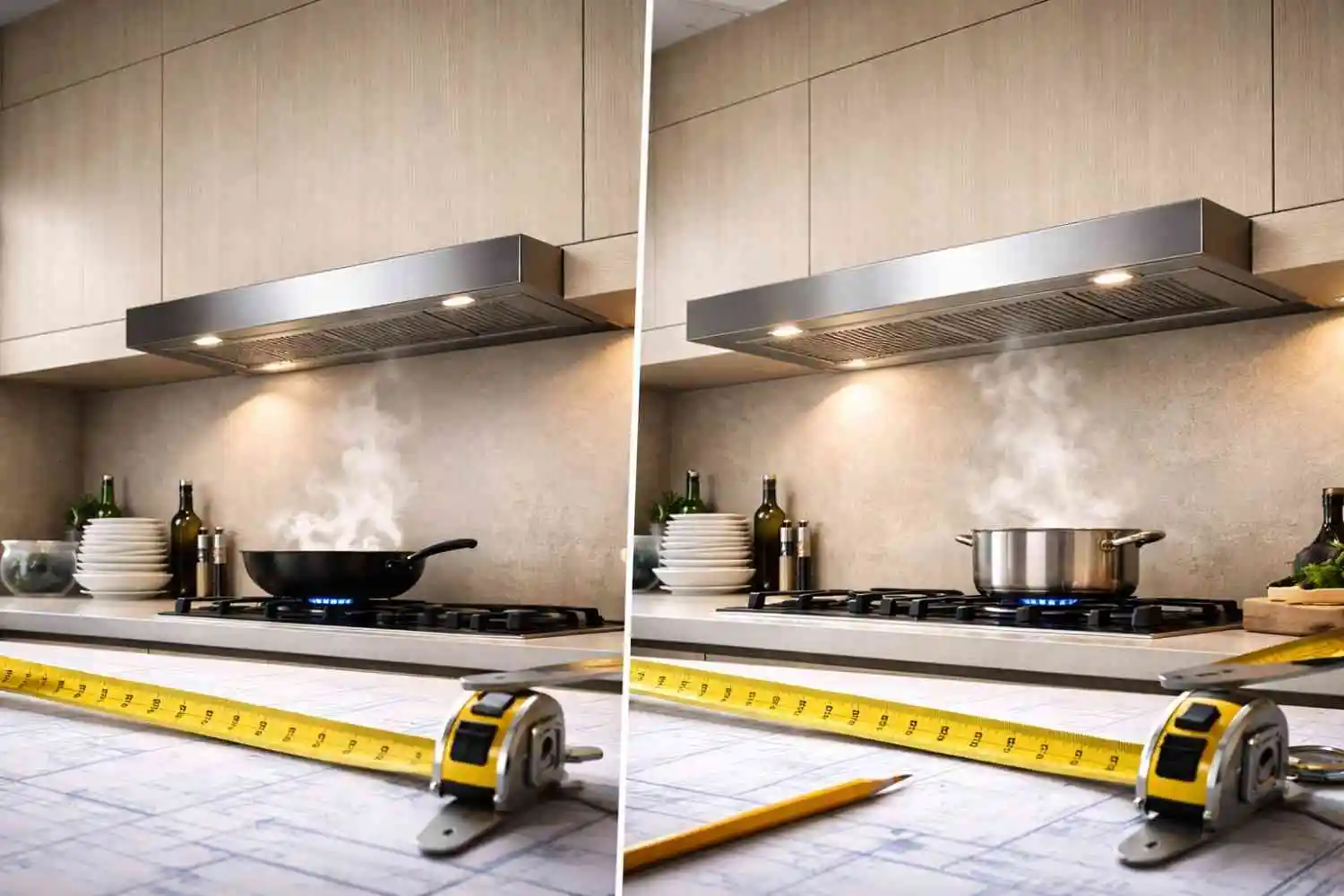
60cm vs 90cm Straight Line Chimney – Size Guide
Standing in a new kitchen and trying to decide between a 60cm and 90cm chimney can feel like guesswork. Both look similar in photos, both are called straight-line chimneys, and both claim powerful suction. Yet choosing the wrong size can leave smoke escaping from the sides, cabinets getting sticky, and your kitchen never quite smelling fresh.
This detailed straight line chimney size guide explains exactly how to choose between 60cm vs 90cm Straight Line Chimney models. You’ll see how kitchen size, cooktop width, number of burners, and cooking style all affect the best chimney size for your home, so you don’t end up overbuying or under-protecting your kitchen.
Kitchen Size Logic for Chimney Selection
The first step in picking the right size isn’t the chimney itself. It’s your kitchen. The physical space decides how much smoke builds up and how quickly your chimney must remove it. This is also where most people figure out whether to look at 60cm or 90cm models in the range of 60cm & 90cm Straight Line Chimneys.
1. How kitchen width and cooktop size impact chimney selection
Think of your kitchen in two dimensions:
1. Width of the wall where the hob is installed
2. Overall volume of the kitchen space (length × width × height)
A narrow wall with limited cabinet width usually suits a 60cm chimney, while a wider wall can easily accommodate a 90cm chimney. At the same time, a bigger kitchen volume means more air and more smoke to manage, so a larger chimney with higher suction makes more sense.
Your cooktop size then becomes the second deciding factor. The chimney should match or slightly exceed the hob width. If your hob is 60cm, a 60cm chimney is typically enough. For an 80–90cm hob, stepping up to a 90cm chimney gives you better edge-to-edge coverage. This is the heart of the chimney size for kitchen logic.
2. Compact, medium, and large kitchens
To make it easier to visualise, think of your kitchen in three broad categories:
● Compact kitchens
○ Narrow countertops, limited walking space
○ Usually found in apartments or studio homes
○ Typically pair with a 2–3 burner hob
○ Often best served by a 60cm straight-line chimney
● Medium kitchens
○ Enough room for 2 people to cook together
○ Common in most Indian homes
○ Usually have a 3–4 burner cooktop
○ Can use either 60cm or 90cm, depending on hob width and cooking style
● Large kitchens
○ Spacious modular layouts, often open to dining/living area
○ Frequently feature 4–5 burner hobs
○ Generate more heat and smoke from multiple dishes
○ Benefit most from a 90cm straight-line chimney with higher suction
3. Why the correct chimney size improves smoke and odour capture
Hot air and fumes rise upward in a roughly vertical column. If the chimney hood is narrower than the cooktop, smoke from the side burners can drift past the edges and spread through your kitchen. With the right-sized chimney, the hood “covers” the entire cooking zone, creating a strong pull directly above all burners.
That’s why choosing correctly between a 60cm vs a 90cm Straight Line Chimney is more than a cosmetic decision. The right width:
● Captures more smoke before it escapes
● Reduces sticky oil buildup on cabinets and walls
● Keeps the kitchen smelling fresher, especially during heavy Indian cooking
In short, the correct size protects both your health and your kitchen finishes.
Stove Burners and Chimney Size
Once you understand your kitchen layout, the next step is to match chimney size to your stove width and number of burners. This is where size selection becomes very clear.
1. Relationship between stove width and chimney width
Your chimney should ideally be:
● Equal to the width of the hob, or
● Slightly wider than the hob, if space allows
If the chimney is narrower, the side burners won’t sit fully under the suction area. When all burners are on, smoke from the outer sides can easily escape into the room.
This simple rule, together with your kitchen size, forms the backbone of every solid chimney size for kitchen recommendations.
2. 2–3 burner stoves → 60cm chimney
Most 2-burner and compact 3-burner cooktops are around 55–60cm wide. For these, a 60cm straight-line chimney is usually the most practical and efficient choice:
● Fits comfortably in small wall spaces
● Provides enough coverage for all burners
● Keeps costs and power usage moderate
If your kitchen is compact and you cook for 2–3 people, a 60cm chimney often gives all the performance you need without overpowering the space.
3. 3–4 burner stoves → 90cm chimney
Regular 3–4 burner hobs, especially wide ones, can be 75–90cm or more in width. Here, a 90cm chimney becomes the best chimney size choice in most cases:
● Ensures full coverage across all burners
● Handles parallel cooking (curries, rotis, frying) better
● Performs noticeably better in medium to large kitchens where fumes spread quickly
If you frequently use 3 or 4 burners at once, going for a 90cm unit helps avoid smoky corners and half-protected pots.
4. Coverage logic explained simply
A good way to remember it:
● If your hob fits under a 60cm rectangle, choose a 60cm chimney.
● If your hob extends beyond 60cm and is closer to 90cm, a 90cm chimney will serve you better.
For a broader context that includes suction, motor type, and features, you can also refer to the full buying guide: How to Choose the Right Straight Line Chimney. That guide combines size selection with other practical decisions.
60cm vs 90cm Straight Line Chimney – Recommendation Table
Here’s a quick, at-a-glance straight line chimney size guide to help you compare both sizes side by side.
| Criteria | 60cm Straight Line Chimney | 90cm Straight Line Chimney |
| Kitchen Size | Small to medium | Medium to large |
| Stove Type | 2–3 burner | 3–4 burner |
| Suction Requirement | Moderate | High |
| Cooking Style | Light to moderate | Heavy Indian cooking |
| Recommended For | Compact kitchens | Spacious modular kitchens |
In simple terms, a 60cm model suits compact, lighter-use kitchens, while a 90cm model is usually the better choice for busy Indian families and larger modular layouts where multiple burners are used regularly.
Making the Final Size Decision
When you compare a 60cm vs a 90cm Straight Line Chimney, don’t just look at the price tag or pictures. Match the chimney width to your hob, think about how big your kitchen really is, and be honest about your cooking style. If you mostly cook light meals on two burners, 60cm is usually enough. If you regularly use three or four burners and love heavy Indian dishes, a 90cm chimney will feel like the right investment from day one.
Once you’ve decided on the best chimney size for your space, you can explore real products, compare features like suction and auto-clean, and pick the right finish for your kitchen from the full range of 60cm & 90cm Straight Line Chimneys.
FAQs
Neither size is “universally” better; it depends entirely on your hob width and kitchen size. For smaller kitchens with 2–3 burner stoves, a 60cm model usually works best. For medium to large kitchens and 3–4 burner hobs, a 90cm model normally offers better coverage and smoke capture. The whole point of a 60cm vs 90cm Straight Line Chimney comparison is to match size to your actual usage.
Yes, in many cases, a 60cm chimney is enough for a compact 3-burner hob, especially if the hob width is close to 60cm and your kitchen is small to medium in size. If the hob is wider or you use all three burners heavily at the same time, stepping up to a 90cm chimney can give more comfortable coverage.
Choose a 90cm chimney when:
● Your hob is wide (typically 75–90cm)
● You have a 3–4 burner stove that you use actively
● Your kitchen is medium to large, or open to dining/living areas
● You cook heavy Indian meals with lots of frying and tadka
In these conditions, a 90cm straight-line chimney is closer to the best chimney size for performance and comfort.
Chimney size and suction are related but separate factors. A wider chimney covers more area and can capture smoke from more burners, but effective performance still requires suitable suction power. For example, a 90cm chimney with low suction may not perform as well as a 60cm chimney with higher suction in a very smoky kitchen. The ideal scenario is matching both size and suction correctly using a solid, straight-line chimney size guide.
Most Indian kitchens with standard 3–4 burner hobs and regular frying benefit from 90cm chimneys, especially in medium or large spaces. However, compact urban kitchens with small 2–3 burner stoves often do perfectly well with a 60cm chimney. The “best” size is the one that matches your hob width, kitchen volume, and cooking intensity.
Technically, you can, but it’s not ideal. A 4-burner stove is usually too wide to sit comfortably under a 60cm hood. Smoke from the outer burners can escape around the edges, reducing efficiency. For 4 burners, a 90cm model is usually recommended as the more suitable chimney size for kitchen layouts.
For modular kitchens, start by measuring the hob and wall width. Then:
● Match chimney width to hob width (60cm or 90cm)
● Make sure the chimney fits neatly between or under cabinets
● Consider overall kitchen size and how often you use multiple burners
A modular kitchen with a 3–4 burner hob and regular Indian cooking usually works best with a 90cm straight-line chimney.
A bigger chimney doesn’t automatically consume more power, but models designed for more extensive coverage often come with higher suction motors, which may use more electricity at full speed. However, because they clear smoke faster, you might run them on lower speeds most of the time. Always compare both size and motor rating when choosing the best chimney size for efficiency.
The most common standard sizes for straight-line chimneys in India are 60cm and 90cm. These match the typical widths of Indian hobs and cooktops. That’s why discussions around 60cm vs 90cm Straight Line Chimney are so central to any buying decision.
Chimney size by itself doesn’t create noise. Noise mainly comes from the motor, air movement, and design. However, larger chimneys often have stronger motors, which can be noisier at top speed if not well-engineered. When comparing 60cm and 90cm options, check the noise level (in dB) in addition to size and suction, so you can balance performance with comfort in your kitchen.
